
The difference between a good and bad (fitness) challenge can make all the difference in the world.
A BAD challenge: pushes people constantly beyond their limits, leading to burnout or injury, and is ultimately demoralizing. It tries to do too much at once, throwing everything at the wall and causing overwhelm. It lacks a reasonable timeframe and a clear, logical connection to a long-term fitness solution. Lastly, a bad challenge is often centered around a gimmick rather than proven, productive methods, leading to a mindset of chasing fads instead of cultivating effective habits and principles.
However, there’s an important saying: abuse does not negate proper use.
This is especially true with challenges. While many fitness challenges are poorly constructed, random, and unreasonable, many others are excellent. In fact, some of the most significant, lasting changes I’ve seen in people started with them engaging in a well-designed fitness challenge. They got excited, saw results, stayed motivated, and KEPT GOING.
So, what makes a GOOD challenge?
A GOOD challenge: occasionally pushes people to their limits, helping those limits expand, and is ultimately highly encouraging. It focuses on just a few simple things, keeping tasks manageable and realistic. It has a reasonable, well-defined timeframe and presents a clear progression for what comes next. A good challenge has an exciting hook that draws people in, but it’s based on a proven, effective process that educates and serves people in the long term.
Moreover, a good challenge can be the true secret to self-reliance. An effective challenge first finds external motivation through communal activity, accountability, and the promise of exciting outcomes, and then transitions to internal motivation, where one acquires the habits and intrinsic drive to continue the hard work automatically. When done right, challenges are GREAT for this.
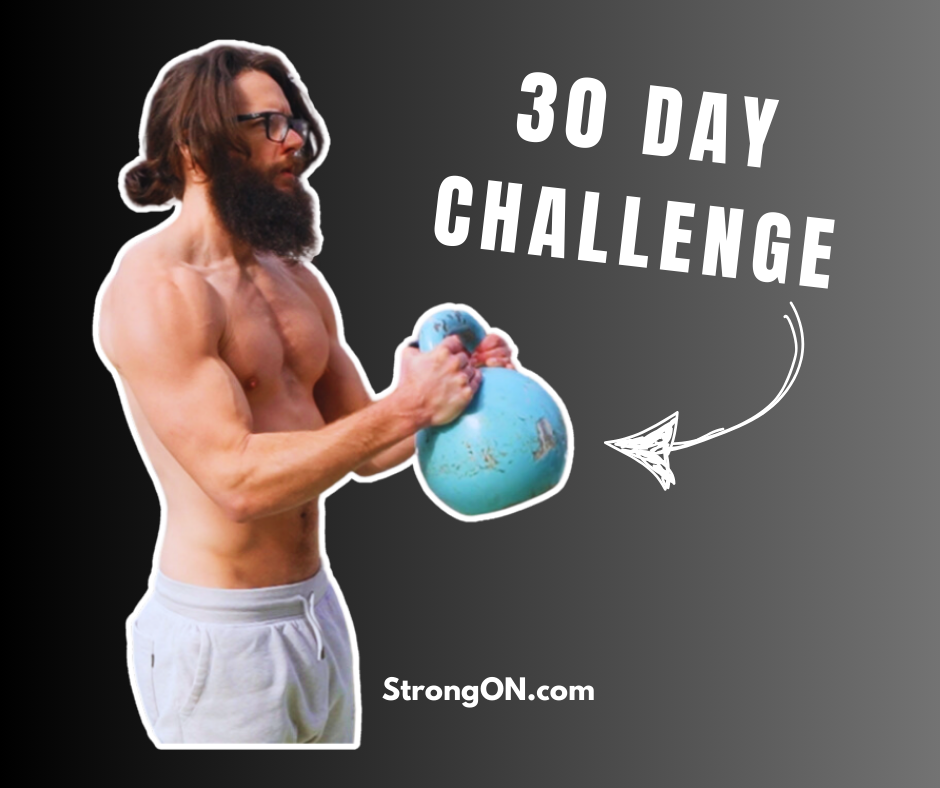
At the risk of sounding immodest, let me propose my 300 Swings Challenge as an example of a GOOD challenge. Here’s why:
1. It works. Over the past decade, the 300 Swings Challenge has consistently produced impressive results in (literally) thousands of people.
2. It’s challenging, but doable. The daily target of 300 swings can be achieved through various weights and methods, making it challenging yet adaptable to each individual. It leaves participants feeling successful, which is key!
3. It’s purposeful. The kettlebell swing is a fundamental exercise upon which many others are built (single-arm swings, cleans, snatches, etc.). This challenge helps you master an essential movement—what Dan John calls the ultimate “fat-burning, athlete-builder”—rather than focusing on a cheap gimmick.
4. It’s realistic. The daily assignments don’t take long to complete, and the 30-day timeframe is manageable yet long enough to see results and build momentum.
5. It’s habit-building. The 300 Swings Challenge gets people into the rhythm of movement, a fantastic habit for long-term health. It fosters intrinsic capability and self-reliance in participants’ health and exercise routines. Thirty days is a good amount of time to build a lasting lifestyle pattern, setting a foundation for long-term success—not just with technique, but with integrating exercise into daily life in a manageable, time-efficient way. (And no, you don’t need to do 300 swings forever; the benefits extend far beyond that.)
OK, let’s now show you a beginner-friendly 300 Swings Challenge.
Leave a Reply